
Coffey County Court Records After Arrest
The arrest-to-court path in Coffey County runs from booking at the Coffey County Sheriff's Office Kansas Detention Center to prosecutor review and then to Coffey County District Court. The jail roster shows booking charges and bond while the person is in local custody. The Coffey County Attorney decides how charges proceed in court. The official county attorney page describes that office as a criminal prosecution agency that enforces felony, misdemeanor, traffic, juvenile, care and treatment, civil asset forfeiture, and post-conviction matters.
The court record is different from the jail record. Jail data can identify the person, booking number, booking date, arresting agency, custody status, listed charges, and bond. Court records after a jail arrest identify the filed case, charging document, case number, hearing activity, warrant events, bond orders, charge status, plea or trial result, and sentencing when applicable. For custody and booking details, use Coffey County jail inmate records. For booking-photo questions, use Coffey County jail mugshots.
The process can be read as a short flow: arrest, booking, first appearance, prosecutor review, filed charging document, court case, disposition. Each stage may use similar charge words, but each record has a different purpose.
Search Court Records After Arrest
Kansas Judicial Branch provides district court record access through the Search District Court Records information page and the Kansas District Court Public Access Portal. Exact live portal fields were not fully available from the public page during source inspection, but Kansas courts identify the system as a public case-search portal. Court records can also be searched at courthouses using a public computer reserved for case information and court records in that court.
- Collect the name, booking date, booking number, and listed charges from the Coffey County roster.
- Open the Kansas District Court Public Access Portal and search by party name or case number when known.
- Limit to Coffey County if the portal offers a county filter, or use the courthouse terminal when the online search does not return the case.
- Open the criminal case and compare each filed count with the booking charge shown by the jail.
- Check later entries for amended charges, dismissed counts, bond changes, warrants, plea settings, trial dates, or sentencing.
The Kansas case-search screenshot captured from the Kansas District Court Public Access Portal is the matched image for this court-record lookup page.
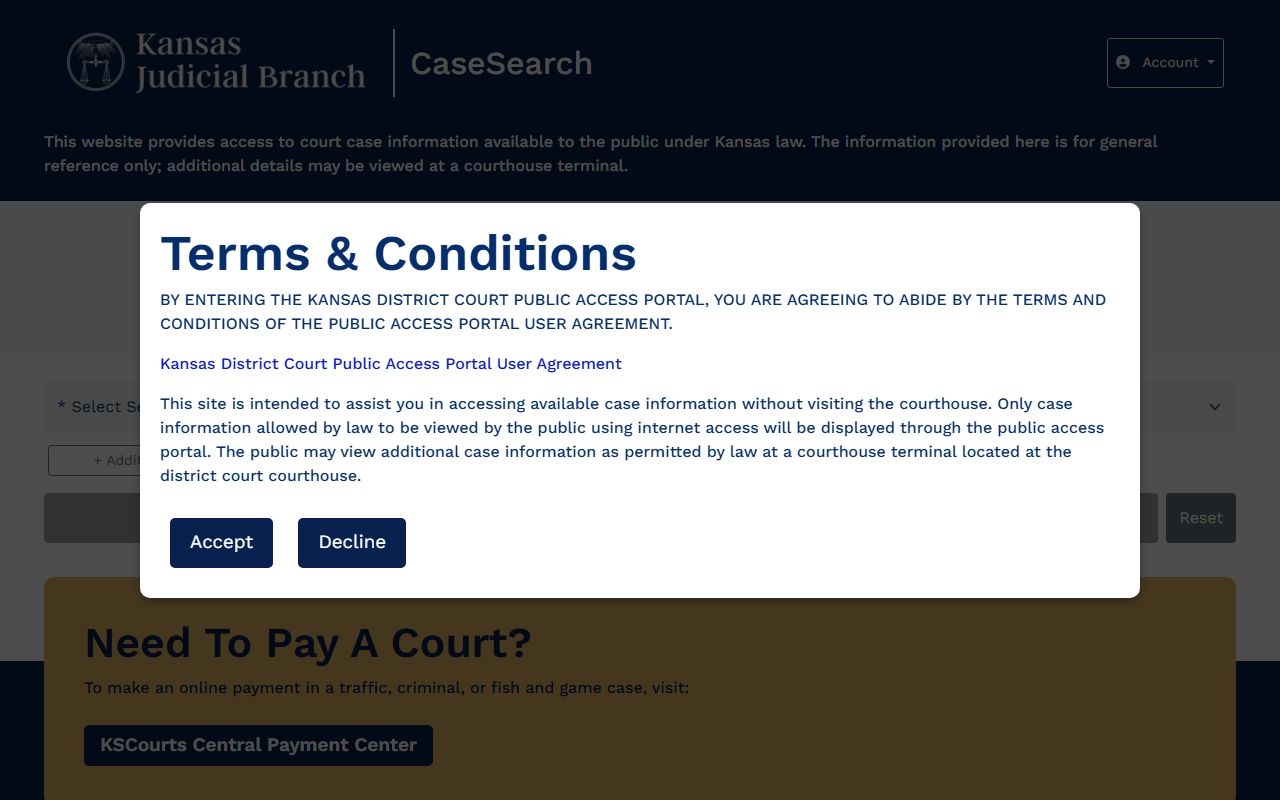
The portal is statewide, so Coffey County users should keep the county, defendant name, and case number close at hand before comparing a court record with a jail booking entry.
Coffey County Court Search Fields
Kansas court records have a partial search-field inventory in the official source set. Exact live form labels were not fully inspected because of the portal access barrier, so these fields should be treated as the documented search paths rather than a promise that every field appears on every screen. If the online portal is down, blocked, or missing an older case, use the Coffey County courthouse public terminal.
| Field Label | Type | Required | Options / Format Notes |
|---|---|---|---|
| Case number | Text | Optional | Use the Coffey County criminal case number if it is known from court paperwork. |
| Party name | Text | Optional | Search the defendant name; spelling variants can matter. |
| County | Dropdown or filter | Optional | Limit to Coffey County if the portal offers a county filter. |
| Public courthouse terminal | In-person search | n/a | Use when the portal is unavailable or the record is not online. |
Coffey County District Court is part of the Kansas 4th Judicial District. The County Attorney generally practices in the District Court of Coffey County, Kansas, and may also handle matters in the Kansas Court of Appeals and Kansas Supreme Court. That means the local case search should start with district court records, then widen only if the case has been appealed or transferred.
Coffey County Charging Documents
A jail arrest does not, by itself, prove that the same charge will be filed in court. The booking charge is the arrest-side allegation entered by the jail. A formal court record begins when a charging document is filed. In Coffey County, the County Attorney reviews facts, decides whether charges should be filed, and can amend, reduce, dismiss, add counts, or negotiate pleas as a case develops.
| Document | Who Files or Returns It | Common Use | What It Starts |
|---|---|---|---|
| Complaint | Officer or prosecutor | Often used at the start of a criminal case. | Initial court charge record after arrest. |
| Information | Prosecutor | Used by the prosecutor to state formal charges. | Filed case counts and later case events. |
| Indictment | Grand jury | Used less often and tied to grand jury action. | Formal charges returned by a grand jury. |
The main Coffey County prosecutor contact is the Coffey County Attorney's Office at 110 S 6th Street, County Courthouse, Room 204, Burlington, KS 66839. The office phone is 620-364-5111, with hours listed as Monday-Friday, 8 a.m.-12 p.m. and 1 p.m.-5 p.m. The elected County Attorney is Wade H. Bowie II.
Coffey County Charge Status Records
Charge status explains what has happened to an accusation after the court case opens. A Coffey County booking record can show one charge description while the court case later shows an amended count, a dismissed count, an added count, or a plea to a different charge. This is why court records after a jail arrest should be checked after first appearance and again after later hearings.
| Status | What It Means | Why It Matters |
|---|---|---|
| Pending | The charge is active and not yet resolved. | Future hearings, bond terms, and plea or trial settings may still change. |
| Amended | The prosecutor changed the charge language or count. | The filed court charge may no longer match the jail booking charge. |
| Reduced | The charge level or offense was lowered. | Potential penalties, bond posture, and plea terms can shift. |
| Dismissed | The court case or count was ended without conviction on that count. | The arrest record may still exist unless expungement or another order limits access. |
| Convicted | A plea or verdict resulted in guilt on a charge. | The record becomes a conviction record, not just an allegation. |
Some docket words are easy to misread. A dismissal does not always erase a booking record. A reduced charge does not mean the original arrest never occurred. A pending warrant entry may reflect missed court or another agency's interest rather than a new local arrest. For current bond and hold status, the jail profile itself directs people to call detention staff.
Bond Warrants and Prosecutor Path
Bond records connect the jail side and the court side. Coffey County roster profiles can list a bond amount, but the profile warning says charges and bail amounts may change after court appearances. It tells bond companies and people posting bail to contact detention staff at 620-364-3199 for the correct bail amount, charges, and case numbers. That local instruction should be followed before paying a cash bond or contacting a surety company.
The sheriff's bonding-agencies page is labeled as an approved bonding agency list through 12/31/2026, updated 04/08/2026 by Coffey County District Court. Surety bond uses one of those approved companies. Cash bond is paid directly. Personal recognizance, often called PR bond, means release on a promise and court conditions. A no-bond hold, other-jurisdiction hold, parole or probation hold, municipal commitment, or person waiting for a KDOC bed may not be released by paying one Coffey County bond line.
No official Coffey County active warrant search page was found. Warrant-related bookings still appear on the sheriff roster with wording such as warrant arrest, failure to appear, or other jurisdiction hold. A bench warrant is usually issued by a judge after missed court or failure to comply with a court order. For a warrant tied to an existing case, search Kansas District Court records, use the courthouse terminal, or contact the relevant court or attorney.
Coffey County Charge vs Conviction
An arrest and a charge are not the same as a conviction. Kansas law allows an officer to arrest in listed circumstances, including warrant arrests and probable-cause arrests under K.S.A. 22-2401. A charge is still an accusation. A conviction requires a guilty plea, no-contest plea accepted by the court, or a verdict after trial. Coffey County profiles also state that all persons are presumed innocent until proven guilty.
| Record Type | Meaning | Where It Appears |
|---|---|---|
| Booking charge | Alleged offense entered when the person is booked. | Coffey County jail roster profile. |
| Filed charge | Count the prosecutor files in court. | Kansas District Court case record. |
| Amended charge | Charge changed after review or negotiation. | Court docket and charging documents. |
| Conviction | Final guilty result on a charge. | Court disposition and, after prison sentence, KDOC KASPER may show conviction details. |
Sealed vs Expunged Records
Kansas public records law begins with openness. K.S.A. 45-216 states the policy that public records are open unless another law provides otherwise. K.S.A. 45-221 lists exemptions and limits that can affect law-enforcement and criminal-investigation records. For qualifying arrest records, convictions, and diversions, Kansas expungement statutes are the legal path for limiting public access.
| Access Limit | Plain Meaning | Kansas Path |
|---|---|---|
| Sealed | Hidden from ordinary public access, with limited access for allowed parties. | Depends on the court order and record type. |
| Expunged arrest record | Qualifying arrest access is limited by court process. | K.S.A. 22-2410. |
| Expunged conviction or diversion | Qualifying conviction, arrest, or diversion record is limited by court process. | K.S.A. 21-6614. |
Expungement does not mean every old web copy vanishes at once. It also does not change the fact that a jail roster may have displayed a booking while the case was new. Anyone seeking record relief should use the court process rather than asking a roster page to decide legal eligibility.
Coffey County Records Requests
When a court or jail record is not online, use the right office for the record type. Formal filed charges and court events belong with Kansas District Court records or the Coffey County courthouse. Sheriff booking records, older jail records, incident reports, and records not shown on the roster route through the sheriff's Open Records Request page or form. The sheriff records page cites K.S.A. 45-230 and warns against using names and addresses taken from public records for commercial solicitation.
The sheriff's records form asks for requester identity and contact information, approximate date and time, location, optional case number, and a description of the information requested. The records page says the office may email for fee authorization before completing a request. Published sheriff fees include $2.50 for digital report copies, $2.00 by mail, and $15.00 for DVD. Those are sheriff records fees, not court filing fees.
Coffey County Court Record Limits
KDOC KASPER is not a full criminal-history search. KDOC says KASPER covers offenders sentenced to Kansas corrections custody since 1980, including current incarceration, post-incarceration supervision, and discharged sentences. It does not replace a case search for new Coffey County court records after a jail arrest. It becomes useful when a sentenced person transfers from the county jail into KDOC custody or appears under KDOC supervision.
Federal and immigration custody use different systems. BOP covers federal sentenced prisoners. ICE ODLS covers people in ICE custody and people in CBP custody for more than 48 hours. No federal or ICE detention facility was found inside Coffey County, and those systems should not be described as Coffey County court records. They are fallback locators when a local jail or Kansas court search no longer explains where a person is held.
Important: Do not use casual court or jail searches for credit, employment, tenant, insurance, or other FCRA-covered screening.